Have a project in mind? Get in touch.
Let's talk about your projectCABBI Data Modeling Hub
Summary
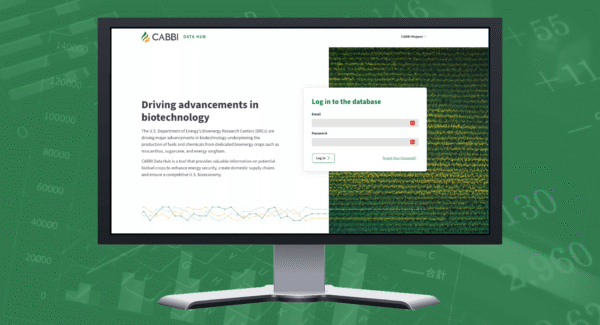
Funded by the Department of Energy, the Center for Advanced Bioenergy and Bioproducts Innovation (CABBI) develops sustainable energy sources through efficient growth of bioenergy crops and the conversion of biomass into valuable chemicals. Essential to CABBI’s success is its database system, which supports research, agriculture, and policy by synthesizing available information on potential biofuel crops. To advance its mission, CABBI recognized the need to revamp this existing system to better serve the researchers and data modelers working on the project.
The challenge: a clunky interface, an isolated tech stack, and functional bugs made the system difficult to use and support.
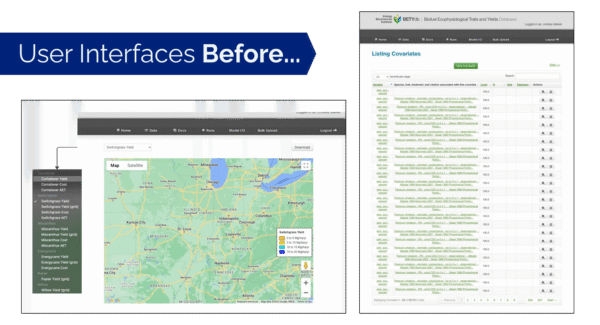
CABBI’s existing system presented several challenges that hindered its data modelers’ work. Key issues included a lack of user-friendliness, difficulty accessing and extracting necessary data, and disruptive functional bugs. In addition, the system was built in Ruby, a technology platform not supported by its parent organization, the Institute for Genomic Biology (IGB), prompting CABBI to seek a new solution.
The solution: a custom database framework + accessibility and UX improvements
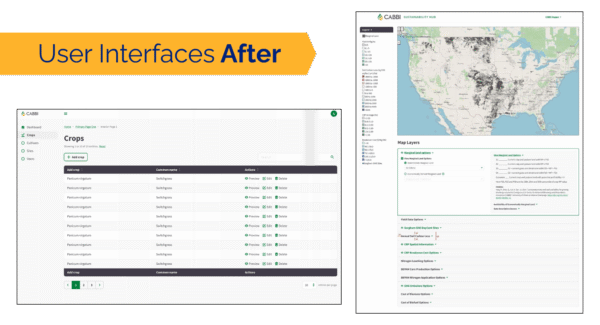
To address the challenges and meet the requirements of CABBI’s data modelers, we implemented a custom database framework and made accessibility and UX improvements to CABBI’s data map and user interfaces. Our aim was to create a simple, stable, and efficient system that made it easy for researchers and data modelers to navigate, filter, import, and export data seamlessly.
The Pixo team used a comprehensive approach to build out this solution:
- Requirement gathering: Consultations with researchers and data modelers to understand their needs and pain points in the existing system.
- Technology migration: Switching frameworks from Ruby to Laravel to ensure long-term support and compatibility.
- Streamlined user interface: Designing an intuitive and clutter-free user interface, removing unnecessary features, and focusing on essential data access and visualization functionalities.
- Data integrity: Enabling the CABBI team to seamlessly migrate and preserve existing data, preserving their core research efforts.
- Data support: Allowing upload, filtering, and download of data, including lat/long bounds to get localized data.
- Hierarchical user management: Implementing user roles and permissions to manage access and security efficiently.
The result: significant improvements to CABBI’s usability and maintainability
The redesigned CABBI system delivers several key advantages to researchers and modelers as well as its administrators:
- Simplified data access: Researchers and modelers can now access and retrieve the needed data without unnecessary complexities.
- Increased efficiency: The stable and intuitive interface improves workflow efficiency, saving time and effort for the research team.
- Enhanced data visualization: The system gave the CABBI team a more seamless workflow for creating data visualizations and analyzing and interpreting research.
- Technology support: Re-platforming CABBI enabled internal support from IGB, operationally solving for its long-term sustainability and maintenance.
The successful implementation of the custom database framework addressed CABBI’s challenge of providing a user-friendly, efficient, and stable system for their researchers and data modelers. CABBI is now better equipped to enact its mission of developing sustainable energy sources and reducing dependence on fossil fuels.