Have a project in mind? Get in touch.
Let's talk about your projectCentralizing critical knowledge: a resource hub for highway maintenance leaders
Summary
Highway maintenance leaders face increasingly complex decisions—from managing aging infrastructure and extreme weather events to implementing performance-based maintenance strategies with limited time and resources. Yet critical guidance, research, tools, and peer examples are often fragmented across organizations, publications, and institutional knowledge. To help address these challenges, Pixo partnered with Applied Pavement Technologies (APTech) and the National Academy of Sciences National Cooperative Highway Research Program to create the PBM4M Highway Maintenance Document Library, an open-access digital resource designed to centralize knowledge, improve discoverability, and support maintenance professionals nationwide.
The challenge: Connecting maintenance leaders with timely, actionable knowledge
Transportation agencies rely on a wide range of stakeholders—including maintenance program managers, engineers, asset managers, supervisors, planners, and analysts—to make informed operational decisions. But accessing relevant guidance or learning from peer agencies can be difficult when resources are dispersed across multiple systems and formats.
Further, many of these professionals work in environments where timely access to information matters, and desktop access isn’t always guaranteed—creating additional pressure for resources to be intuitive and usable across devices.
This initiative required a platform that could:
- Serve as a centralized, trusted source for highway maintenance resources;
- Organize a growing body of content in ways that remain intuitive, scalable, and easily searchable over time;
- Reduce barriers to implementing or improving performance-based maintenance programs;
- Support professionals stepping into new maintenance leadership roles;
- Encourage information sharing among state transportation agencies;
- Keep resources openly available without login requirements.
The solution: A searchable, taxonomy-driven document library designed around discoverability
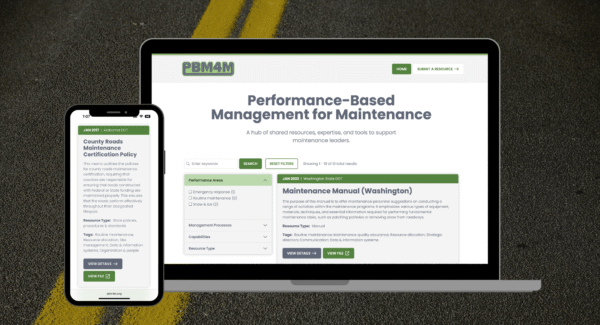
Pixo developed a searchable digital knowledge hub powered by WordPress’s robust taxonomy capabilities, enabling users to quickly locate and filter relevant resources across a broad and evolving collection of materials.
Designed with usability and long-term scalability top of mind, the user experience incorporates:
- Layered navigation and expandable category structures that allow users to browse intuitively without feeling overwhelmed;
- Resource cards with summaries and direct access points, helping users rapidly evaluate relevance before opening materials;
- Responsive, mobile-friendly layouts designed to support users accessing resources from offices, vehicles, field environments, or other on-the-go contexts;
- Searchable metadata and structured content organization that improve internal discovery and increase visibility through search engines;
- Open access to guides, research, policies, webinars, tools, and recordings, eliminating registration barriers;
- A community contribution workflow through the “Submit a Resource” feature, enabling practitioners to recommend new materials or updates and helping the library evolve alongside emerging industry practices and needs;
- Accessibility-conscious presentation of information, exposing key resource details directly on webpages rather than relying solely on linked PDFs.
By combining structured metadata, responsive design, accessibility considerations, and community contribution mechanisms, the platform transforms static document collections into a living knowledge ecosystem that supports maintenance professionals wherever and however they work.
The result: A more accessible hub for shared learning and industry advancement
The PBM4M Highway Maintenance Document Library now provides maintenance professionals with an easier way to discover resources, learn from peers, and access practical guidance when navigating everyday challenges or unexpected circumstances.
The platform helps support:
- Faster access to relevant maintenance resources, on demand and in the field;
- Greater visibility into existing industry knowledge and best practices;
- Reduced friction for professionals implementing or refining performance-based maintenance programs;
- Continued peer learning across state transportation agencies;
- More equitable access to information through open availability and improved accessibility.
Most importantly, the resource hub supports the people responsible for maintaining critical infrastructure—providing tools and knowledge that can strengthen confidence, inform decision-making, and foster continued progress across the field.